
Buddhist funeral arrangements and costs in Singapore
What a Buddhist funeral actually involves, the nine things that move the price, the government fees nobody can discount, what packages usually leave out, and the ten questions to ask before you agree to anything.
On this page — 9 sections
No funeral director in Singapore can honestly quote you a Buddhist funeral price over the phone. Anyone who does is quoting a package, not your funeral. The gap between the least and the most a family might reasonably spend runs to several times over — not because anyone is marking up, but because a three-day wake at a void deck with one chanting group and a five-day wake at a parlour with nightly sessions, an upgraded casket and catering for two hundred are genuinely different undertakings.
This guide explains what drives that difference, which costs are fixed by the government and cannot vary, what packages usually leave out, and what to ask before you agree to anything. It is written to be useful even if you engage someone else.
What a Buddhist funeral involves
Buddhist practice in Singapore is not uniform. Most Chinese Buddhist families here follow Mahayana practice, often with a temple or a particular group of monks the family already has a relationship with. Theravada practice, more common among families with Thai, Sri Lankan or Burmese connections, looks different again. What follows is the common shape, not a rule.
- Immediately after the death. Some families arrange 助念 — continuous chanting beside the deceased — in the belief that the hours immediately after death matter for the passing. If this is wanted it has to be raised at once, because it begins before anything else does.
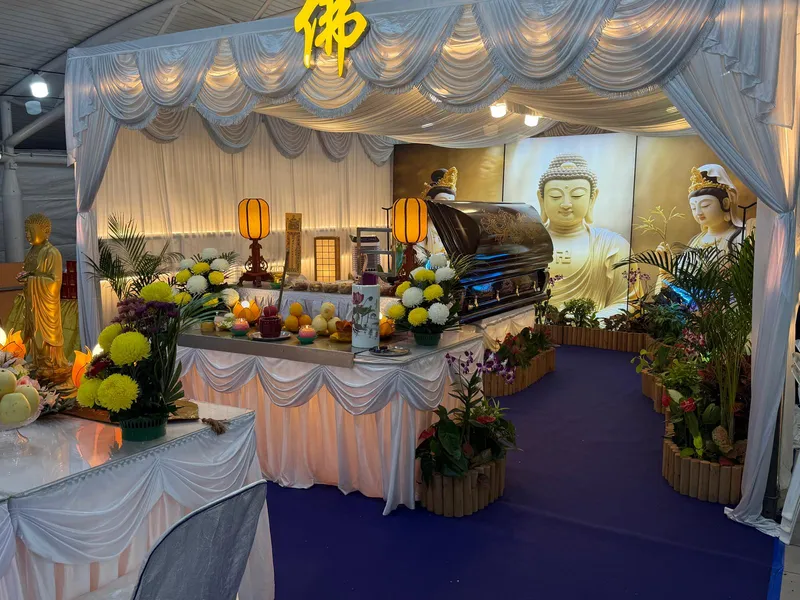
- Encoffining and setting up the wake. An altar with a Buddha or Guan Yin image, the memorial portrait, offerings, and lotus or chrysanthemum flowers rather than the bright arrangements used at a celebration.
- The wake. Commonly three, five or seven days, with chanting on some or all evenings. Relatives visit; the family keeps vigil.
- The final morning. A last chanting service, the sealing of the casket, and the cortege to the crematorium.
- At the crematorium. A short service in the hall before the cremation.
- Afterwards. The ashes are collected and placed. Many families continue with 头七 and the subsequent seven-day observances, and later 百日 and 对年.
Every one of those stages has a simpler form and a more elaborate one. That, not the funeral director's margin, is where the range in price comes from.
The nine things that move the price
1. How many days. The single biggest factor. Each additional day is another day of tentage, lighting, tables and chairs and staffing, and usually another chanting session and another round of refreshments. Three, five and seven days are the common choices, and the number is often set by an auspicious date rather than by preference.
2. Where. An HDB void deck is the least expensive and needs a permit from the Town Council. If you also need the adjacent surface parking lots, that is a separate application to HDB — the Branch Service Line is 1800-225-5432, or submit a request at hdb.gov.sg/efeedback under Car Park, Use of Car Parks for Non-Parking Purpose. A funeral parlour costs more and buys air conditioning, certainty of space and no weather risk. A private residence may require a Temporary Occupation Licence from the Singapore Land Authority if public roads or walkways are used. A temple hall depends entirely on the temple.
3. The casket. The widest range of any single item — a simple casket and a full-glass hardwood one are separated by thousands of dollars. This is where families most often spend more than they meant to, in the moment, out of love. There is no wrong answer, but decide it before you are standing in a showroom at midnight.
4. Chanting and officiants. Who chants, how many of them, how many sessions and for how long. Monks from a temple, a lay Buddhist group, or a mix of both. This is usually billed per session, and the number of sessions is the figure families most often revise upward once the wake has begun — so ask what the package includes and what one more costs.
5. Flowers. The altar arrangement, the surrounds and the wreaths. Fresh costs more than artificial and needs refreshing across a longer wake.
6. Catering and refreshments. Frequently not in the package at all. Across five days with a large extended family it can become one of the biggest lines in the total.
7. Embalming. Necessary if there is to be viewing or an open casket, and normally required if your loved one must travel a long distance or across a border. Without it a wake is still possible, provided the casket is hermetically sealed with no viewing window, for a period not exceeding seven days after the death. Embalming must be carried out at a funeral parlour licensed by NEA. A wake running beyond seven days after the death needs prior written permission from NEA.
8. Transport. Collection of the deceased, the hearse, and buses to take the family to the crematorium.
9. What happens to the ashes. The niche, the urn, the plaque and its engraving usually sit outside the funeral package entirely. Our guide to cremation, columbarium and ash arrangements sets out the government fees in full.
The costs nobody can discount
These are set by the government and are identical whoever you engage. They are the only figures in this subject you can rely on without asking anyone:
- Cremation at a government crematorium — $100 for an adult, $50 for a child under ten
- Cremation at Kong Meng San Phor Kark See Monastery — $327; at Tse Tho Aum Temple — $436
- A standard niche at a government columbarium — $500; a family niche — $900
- Choosing the niche location rather than accepting the next one allocated — a further $250
- Inland ash scattering at the Garden of Peace or Garden of Serenity — $320
Checked against NEA's published guidance on 5 November 2026. Government fees change; confirm before you budget against them.
What packages usually leave out
A package is a sensible starting point. It is not a total. The items below are commonly excluded, commonly assumed to be included, and commonly the reason a final bill is larger than the family expected:
- Catering, drinks and snacks for visitors
- The doctor's fee for certifying the death
- Fresh flower upgrades beyond the standard arrangement
- Additional chanting sessions beyond the number stated
- Additional wake days beyond the number quoted
- The columbarium niche, the urn, and plaque engraving
- Processing of the remains into fine ashes, where they are to be scattered
- 头七 and the later seven-day services, 百日 and 对年
- Tentage extensions, extra tables and chairs, or a generator where the venue needs one
- Ang pow and customary payments to officiants, where the family hands these over directly
There is nothing improper about any of these being excluded. What is improper is not telling you. Ask for the exclusions in writing.
How to read a quotation
The Competition and Consumer Commission of Singapore, working with NEA, published a checklist for precisely this situation. It is built around A.S.K.:
- Ascertain the wishes of the deceased and of the family before making any purchase. A great deal of the overspending in this industry happens because nobody knew what the person would have wanted, and buying more felt safer than buying less.
- Seek answers from the provider — in particular, whether a given item is already inside the price quoted or attracts a further fee.
- Know where to find information, including the terms and conditions and what happens if you cancel or change.
Applied to a quotation actually in front of you, that means asking for it itemised, with three things visibly separated: the funeral director's own services, third-party items bought on your behalf, and government fees paid on your behalf. If what you are handed is a single figure with a list of inclusions underneath, ask for the breakdown. A provider comfortable with their pricing will not mind.
Ten questions worth asking
- What exactly is included, and what is not?
- How many chanting sessions, by how many officiants, and what does one more cost?
- What happens to the price if we extend from three days to five?
- Is catering included — for how many people, and for how many days?
- Which casket is in this price, and what are the next two options above it?
- Are the government fees, cremation and niche, inside this figure or paid separately?
- Who applies for the Town Council permit, and is that fee included?
- Is embalming included, and is it actually necessary for what we have chosen?
- What is the deposit, and what is the cancellation policy?
- Who is our point of contact for the whole arrangement, and are they reachable at 3am?
The last one matters more than families expect it to.
A note on how we price
We publish a starting price for each arrangement and then quote the rest properly. A single number is only ever honest about the floor, because what a family pays depends on what it chooses. A five-day Buddhist wake at a void deck for a large family and a three-day parlour wake for a small one are not the same service; quoting a single price for both means somebody is being overcharged.
What we will do is give you an itemised quotation with the exclusions stated, before you commit to anything, and say plainly when something you are considering will not make a difference worth its cost.
Where practice varies
Two families of the same faith may want quite different funerals, and both are right:
- Mahayana and Theravada differ in the form of the chanting, the officiants and the ritual furniture.
- Temple affiliation often determines who officiates and where the ashes will rest. If the family has a temple, involve them early.
- Dialect custom survives inside Buddhist funerals in Singapore, particularly around encoffining and mourning dress. Our guide to Taoist funeral customs by dialect group sets out those practices in detail, and several carry across.
- Mixed-faith families are common, and a competent funeral director should be able to hold a Buddhist form while making room for relatives who do not share it.
The useful question is rarely “what is correct?” It is “what will this family be at peace with?” — and that is a conversation, not a package.
If this is happening now
Call +65 9100 5735. We answer at any hour, and the first call costs nothing and commits you to nothing. If you have a moment to breathe first, you can contact us or read what to do when a death occurs in Singapore.
Government fees on this page were checked against NEA's published guidance on 5 November 2026 and are subject to change. Everything else describes what is commonly done rather than what is required; a funeral director will confirm what applies to your family.