
Taoist funeral costs in Singapore
What drives the cost of a Taoist funeral, the nine things that move the quotation, what the dialect group actually changes, and the six questions that separate a real quotation from an advertisement.
On this page — 6 sections
No funeral director can quote you a Taoist funeral over the phone without asking which dialect group your family keeps, and any who does is quoting something other than what you will get.
That single question changes the priest, the number of ritual sessions, the paper offerings and often the number of days. It is the single biggest reason the cost of a Taoist funeral varies as widely as it does.
This guide sets out what the money is actually paying for.
How much does a Taoist funeral cost in Singapore?
Our own Taoist arrangements start at $11,800. That is where the arrangement begins, not what every family pays: the figure moves with the nine things set out below, and we bill for what is actually used. We are currently not GST-registered, so a quoted figure is the figure paid.
Our Buddhist arrangements start at $7,500. The gap between the two is real and it is not a mark-up — the reasons are below.
What drives the cost
Four things, and only one of them is optional.
The priest. A Buddhist wake needs a monk or a chanting group. A Taoist wake needs a 道长 of your family's own dialect tradition, because the chanting, the sequence of rites and the language spoken over the deceased differ between Hokkien, Teochew, Cantonese, Hakka and Hainanese practice. That is a smaller pool of people, and for some dialects a much smaller pool. Hainanese and Hakka priests in particular are few, and at short notice may have to be brought in from Malaysia.
More ritual sessions. Taoist rites are performed across the wake rather than concentrated into evening chanting. There is typically an encoffining rite, nightly sessions, and a longer sequence on the final morning before the cortège leaves. More sessions means more of the priest's time and often more assistants.
Paper offerings. Paper houses, cars, clothing, servants and joss paper are burned as part of the rites. A modest set is inexpensive. An elaborate paper mansion is not. This is the single most variable line in a Taoist quotation and the one families most often change their minds about midway.
The final morning. The procession, the rites at the crematorium and the sequence at the columbarium afterwards are all more involved than the Buddhist equivalent, which usually means more staff on the day.
The nine things that move a Taoist quotation
1. Dialect group. Not a surcharge, but it determines priest availability, and a rare-dialect priest at two days' notice costs what scarcity costs.
2. Number of ritual days. Three, five or seven — an odd number is the usual practice rather than a fixed rule. Each additional day adds priest sessions, tentage, catering and staffing.
3. Number of priests. Some rites are performed by one 道长; larger funerals engage a priest with assistants, or two priests for particular sequences.
4. Paper offerings. From a basic set to a full paper house with car, servants and furnishings. Ask to be shown what each tier actually looks like rather than choosing from a word on a list.
5. Venue. A void deck carries no hall charge but needs a Town Council permit. A funeral parlour charges hall hire by the day, set by that parlour and varying widely between them. See our guide on choosing between them.
6. Casket. The same range as any other tradition, and the same advice: this is where upselling most often happens, and a more expensive casket changes nothing about the rites.
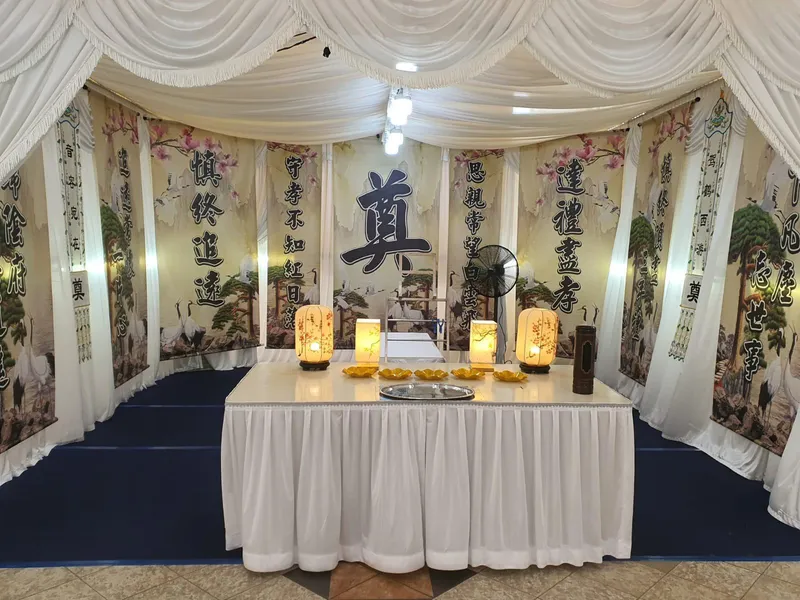
7. Tentage and setup. Scrolls, altar, lanterns, the enclosure itself. A Taoist setup takes longer to build than a plain one, and the scale of it is a real cost.
8. Catering. Vegetarian on ritual days for many families, mixed on others, and this varies by dialect custom as much as by preference.
9. The government fees. Identical for everyone: cremation at Mandai, the niche if you take one, a burial plot if you choose burial, and the inland ash-scattering fee. These are published, no provider can discount them, and any quotation that buries them inside a package total is hiding the only part of the bill that is genuinely fixed.
One fee is commonly listed alongside these and does not belong there. The doctor's fee for certifying the death is a medical charge, not a government fee. It is set by the clinic, hospital or locum service that attends, it varies — a house call at three in the morning is not priced like a weekday consultation — and it is paid to them rather than to any agency. Ask for it as its own line. The same is true of anything bought from a third party on your behalf: a supplier item is not a government charge simply because the funeral director paid it for you.
What the dialect actually changes
This is where a quotation becomes hard to compare, because two providers quoting "Taoist funeral, 3 days" may be quoting quite different work.
Hokkien rites commonly include the 买水 water-drawing ritual. Teochew practice includes paper effigies of servants. Cantonese, Hakka and Hainanese families each keep distinct sequences, and the chanting itself is in the dialect of the deceased rather than in Mandarin.
The practical consequence is simple. If a quotation does not name your dialect anywhere on it, the provider has either not asked or is not planning to arrange a priest of that tradition — and sending the wrong tradition's priest is the one mistake that cannot be fixed on the day.
Our guide to customs by dialect group sets out what differs between the five.
Reading a Taoist quotation honestly
Ask these, in this order:
- Which dialect is this priced for? If the answer is vague, stop there.
- How many ritual sessions, on which days? Not "chanting included" — a number.
- Is the priest confirmed, or to be sourced? These are different promises.
- What exactly is in the paper offerings tier? Ask for a photograph.
- Which government fees are inside this figure and which are not?
- What is not included that most families end up adding?
That last question is the one that separates a real quotation from an advertisement.
What we will not do
Our Taoist arrangements start at $11,800, and we will not quote beyond that figure before asking your dialect, because a single headline number pretends every Taoist funeral is the same. Our own three generations have arranged rites across all five dialect groups, which is precisely why we know the number depends on the answer.
Call +65 9100 5735 at any hour, or contact us and a funeral director will confirm the itemised figure with you before anything is arranged.
If you have not settled where the wake will be held, that decision moves the total as much as anything above: our guide to choosing between an HDB void deck and a funeral parlour sets out both. For the rites themselves, see Taoist funeral customs by dialect group.